Kaneka’s Joint Proposal with Toyooka City Selected as a “Decarbonization Leading Area” by Ministry of the Environment, Government of Japan
-Contributing to the Development of a Regional Microgrid Model that Achieves Both Decarbonization and Economic Viability-
February 26, 2026
The selected proposal aims to revitalize and create regional industries through decarbonization. It promotes power source development such as regional microgrid construction to reduce energy costs, while also implementing both hardware and software initiatives, including the deployment of sustainable tourism in collaboration with a major travel agency.
Under this proposal, Kaneka will construct a regional microgrid (*3) connecting Michi-no-Eki (a roadside station) and surrounding accommodation facilities designated as a regional disaster resilience hub. This will be achieved by introducing on-site PPA solar power generation systems (*4) and large-scale storage batteries, linked via private distribution lines. In addition, as the first initiative of its kind nationwide within Decarbonization Leading Areas, Kaneka will utilize storage batteries installed at PPA customer sites to participate in the Balancing Market (*5). This initiative is designed to enhance not only decarbonization but also economic viability.
Furthermore, off-site PPA arrangements (*6) using underutilized land will be implemented to supplement power supply shortages, establishing a system in which 100% of the electricity consumed at the regional disaster resilience hub is supplied by renewable energy.
These initiatives toward creating a decarbonized tourism region are scheduled to be realized by FY2030. Kaneka intends to position this project as a model case and horizontally deploy it to other regions across Japan, thereby contributing to broader decarbonization efforts.
Based on our mission of KANEKA thinks “Wellness First”, we are committed to creating a society where everyone can benefit from the blessings of nature and access clean, sustainable resources and energy. We contribute to local communities with total energy solutions using our environmentally friendly products such as solar cells and heat insulating materials.
(*1) Proposal Title is “Creating a Sustainable Decarbonized Tourism Region Where the Oriental Stork Takes Flight Revitalizing and Creating Regional Industries, Nature, and Culture through Decarbonization”. Joint proposers include:
Hidaka Kannabe Tourism Association, Climate Integrate, Kaneka Corporation, Hachidori Solar Co., Ltd., Borderless Japan Corporation, The Tajima Bank, Ltd., Tajima Shinkin Bank, JA Tajima, and JTB Corp.
(*2) Regions that aim to achieve carbon neutrality by FY2030 while enhancing regional attractiveness and quality of life, serving as nationwide models.
(*3) A localized energy system that generates electricity using on-site power sources, controls supply and demand with storage batteries and distributes electricity via private lines. The system enables energy self-sufficiency even during large-scale grid outages caused by disasters.
(*4) On-site PPA (Power Purchase Agreement) is a contract structure in which a third party installs solar power generation facilities on a customer’s premises and sells the generated electricity to the customer under a long-term agreement.
(*5) The Balancing Market is a market where “adjustment capacity”—the capability to rapidly balance the gap between power generation and electricity demand—is traded. Because large-scale batteries require significant upfront investment, it can be difficult to recover costs through time-of-day electricity trading alone. However, by providing fast-response adjustment capacity in the Balancing Market, large-scale batteries are expected to achieve improved economic viability.
(*6) Off-site PPA is a contract structure in which power generation facilities are installed off-site, such as on adjacent or remote land, and electricity is supplied to customers under a long-term agreement.
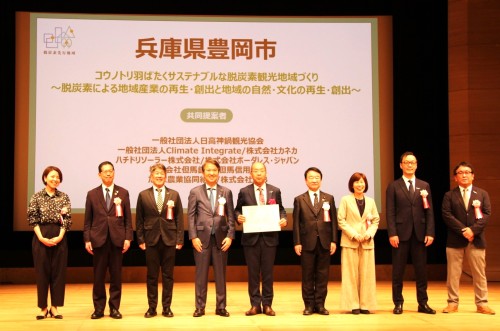
At the Decarbonization Leading Area Designation Ceremony
(From left to right in the photo)
Ms. Mikiko Mine, Head of Public Relations, Borderless Japan Corporation
Mr. Hiroyuki Deguchi, Executive Officer, PV & Energy Management SV President, Kaneka Corporation
Mr. Yasuaki Okafuji, Chairman, Hidaka Kannabe Tourism Association
Mr. Hirotaka Ishihara, Minister of the Environment, Japan
Mr. Hajime Habuta, Deputy Mayor of Toyooka
Mr. Shigeharu Aoyama, State Minister of the Environment, Japan
Ms. Kimiko Hirata, Executive Director, Climate Integrate
Mr. Yasushi Kawaguchi, Chief Operating Officer (COO), Hachidori Solar Co., Ltd.
Mr. Susumu Sone, General Manager, Planning & Development Section, Planning & Development
Produce Center, JTB Corp.
