Safety
Occupational Safety and Health
Safety is a top management priority for the Kaneka Group, and it is our social mission to improve safety. To ensure safe and secure operations, we believe it is important to create a workplace environment where employees can work in good physical and mental health.
Preventing Occupational Accidents
Kaneka Group has set out Zero Accident Principles, requiring every employee to follow them without exception and to act in ways that build a strong safety culture.
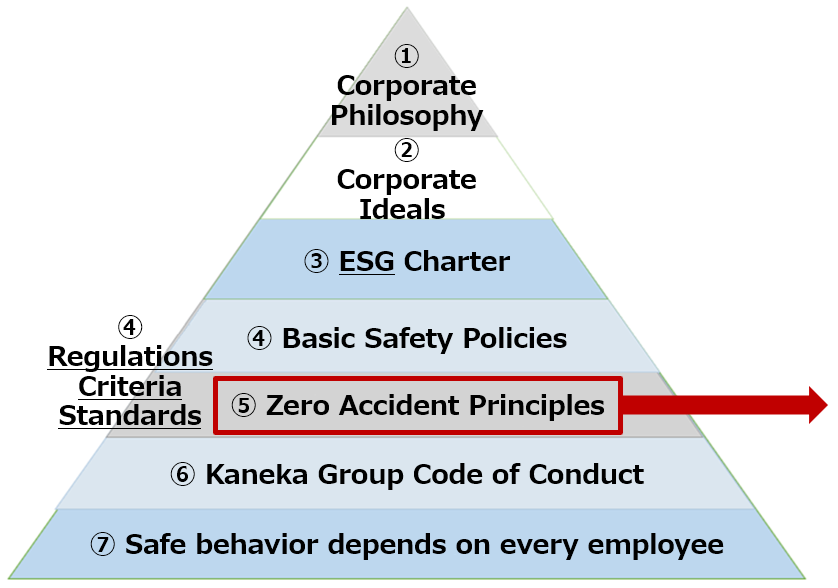
Zero Accident Principles
- All people, you and me, are indispensable
We ensure everyone is working safely.
[Pledge of zero accidents] - Safety is everyone’s responsibility
We do not miss sparing the time to seek safety.
[Participation in safety] - There is no trick to safety
We always value a fundamental approach to it.
[Adherence to safety basics] - Be aware of potential danger
We endeavor to eliminate safety risks
[Safety in advance] - Where there is carelessness, there is the possibility of an accident
We do not allow even a small chance of negligence.
[99%, yet 0%]
As part of our internal audits, we conduct ESG safety and quality inspections of all parent manufacturing sites and Group companies in Japan and overseas. ESG safety and quality inspections are conducted to verify on-site safety management conditions and the implementation of safety activities based on the Safety Committee’s key policies, from the perspectives of occupational safety and health, process safety and disaster prevention, environmental conservation, quality assurance of products and work-in-progress, chemical substance management, and compliance. We evaluate these inspections based on evidence gathered on site, then share any items needing improvements between the head office and manufacturing sites.
In FY2024, we conducted inspections at four parent manufacturing sites (Takasago, Osaka, Shiga, and Kashima), eight Group companies in Japan and three Group companies overseas. We shared best practices to correct and improve areas with issues.
ESG Safety and Quality Inspections: Key Items for Occupational Safety, Health, and Disaster Prevention
(1)Confirming how well occupational safety and health policies are understood and whether plant safety standards are met
(2)Compliance with laws and regulations (including chemical substance management and internal rules such as KGSS(*1))
(3)Implementation and progress management of safety activity plans
(4)Confirmation of the effectiveness of risk reduction measures through change management
(5)Managing work outsourced to partner companies
(6)Renewing aging equipment and actively investing in production facilities
(7)Sharing lessons learned from occupational accidents and process incidents across the organization
(8)Reviewing crisis management documents and systems for natural disasters and emergencies
(9)Conducting emergency response, evacuation drills, and comprehensive disaster prevention drills
*1KGSS (Kaneka Global Safety Standards)
A set of global safety standards shared across the Kaneka Group, both in Japan and internationally, established to eliminate process accidents and occupational accidents. We have established in place implementation standards under the respective management standards for each area (17 for occupational safety, 7 for process safety, and 1 for emergency response). A key feature of our approach is conducting annual gap analyses between our standards and current practices, and ensuring that any gaps are addressed to remain compliance with our standards.
Occupational Accidents
In 2024, the number of occupational accidents decreased from the previous year, and the Kaneka Group's accident frequency rate improved by 0.31 year on year to 0.11. However, occupational accidents caused by insufficient safety awareness continued to occur. The Kaneka Group's accident severity rate fell to 0.00 as the number of serious accidents decreased.
We will continue to promote safety activities based on our Zero Accident Principles, focusing on improving hazard awareness and enhancing equipment safety. We will foster a strong safety mindset among all employees to prevent occupational accidents.
Accidents Resulting / Not Resulting in Lost Time
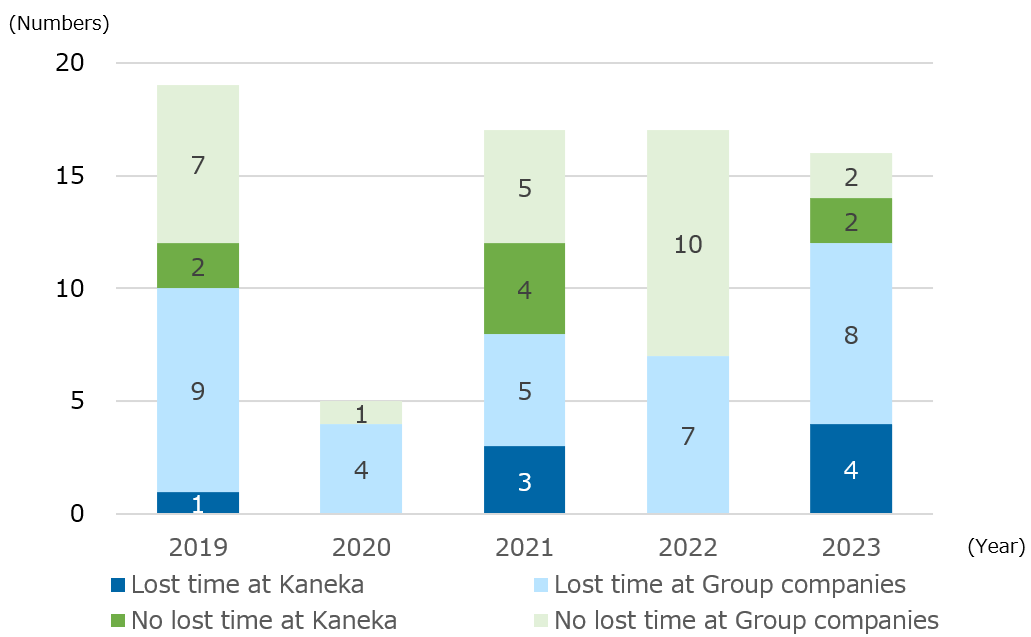
Note:The number of occupational accidents includes those among employees at Kaneka and partner companies working in the Kaneka Group.
Accident Frequency Rate
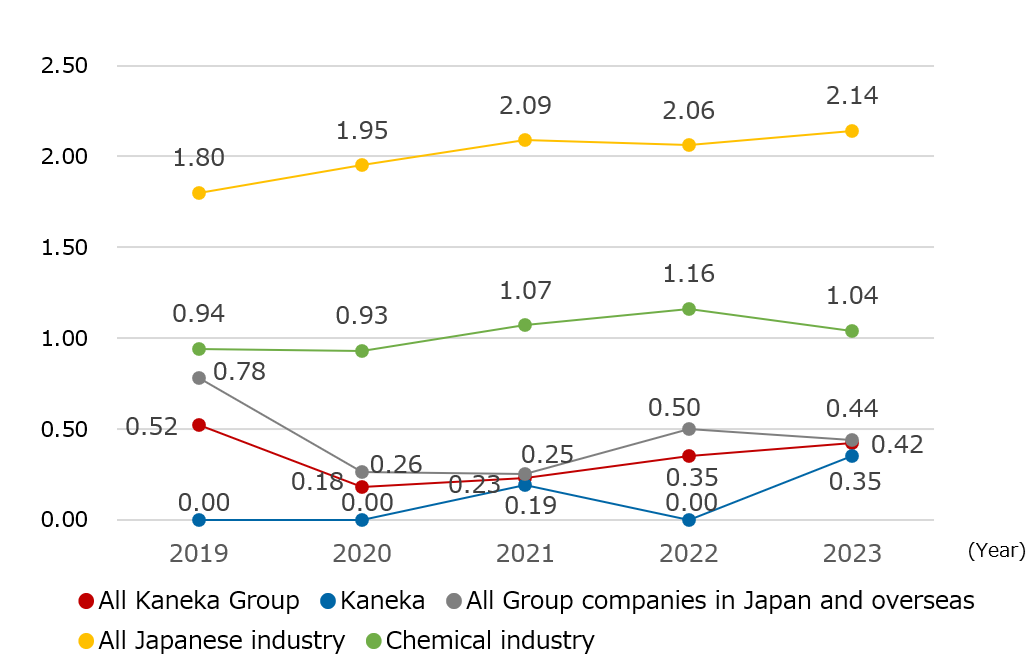
Accident Frequency Rate:An indicator that shows the frequency of occupational accidents that caused death and/or injury by indicating the number of casualties per total 1 million working hours.
Scope:Includes manufacturing sites with regular employees, contract employees, and temporary employees dispatched from other companies. Employees seconded to or from other companies and employees of partner companies are not included.
Accident Severity Rate
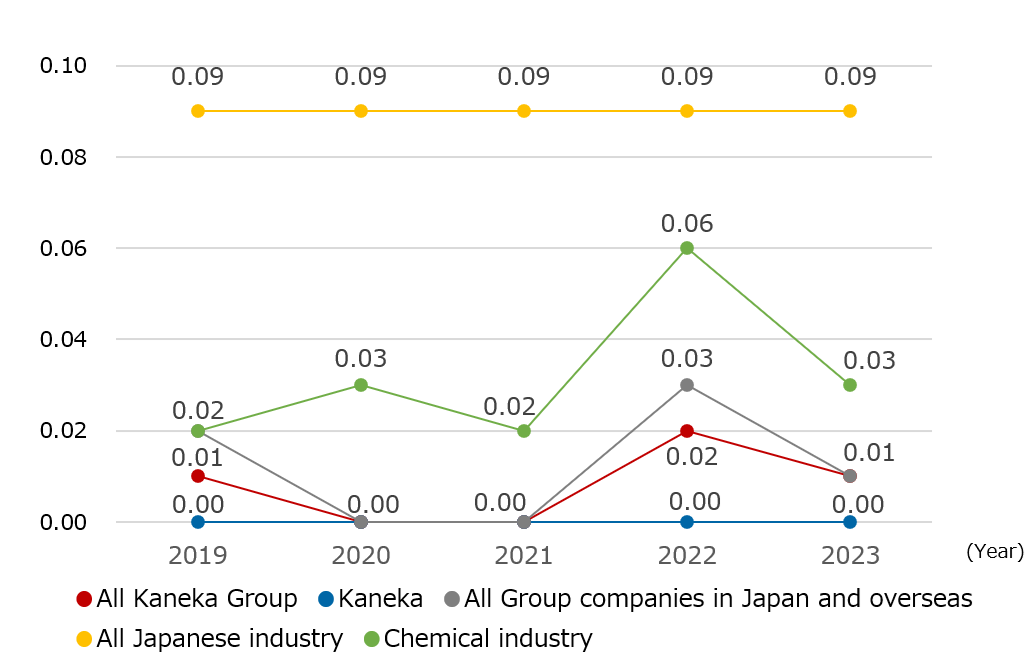
Accident Severity Rate:An indicator that shows the level of severity of occupational accidents by indicating the number of lost work days per total 1,000 working hours. The number of lost work days is calculated as equivalent to the number of days lost from work due to an accident resulting in work absence.
Scope:Includes manufacturing sites with regular employees, contract employees, and temporary employees dispatched from other companies. Employees seconded to or from other companies and employees of partner companies are not included.
Enhancing Our Occupational Safety and Health Management System
Four parent manufacturing sites acquired Occupational Safety and Health Management System (OSHMS) certification from the Japan Industrial Safety & Health Association (JISHA) in FY2007, and have continued our efforts to enhance these systems.
OSHMS Certifications
| Manufacturing Site | Location | Certification Date | Certification No. |
|---|---|---|---|
| Takasago Manufacturing Site | Hyogo | March 10, 2008 | 08-28-13 |
| Osaka Manufacturing Site | Osaka | August 21, 2007 | 07-27-10 |
| Shiga Manufacturing Site | Shiga | January 15, 2008 | 08-25-6 |
| Kashima Manufacturing Site | Ibaraki | December 13, 2010 | 10-8-26 |
Prevention of Slips, Trips, and Falls
Over the past five years (2020 to 2024), the most frequent occupational accidents have been slips and falls and entrapment/entanglement. To prevent accidents from slips, trips, and falls—which are increasing at Group companies in japan—we are focusing on raising safety awareness through the following initiatives.
(1) Strengthening sharing of lessons learned from occupational accidents and process incidents
Based on occupational accidents and process incidents that occurred in FY2024, we identified similar accident risks, shared these findings across our own workplaces, and implemented improvement measures.
(2) Safety training using past incidents
We use past incidents to provide training content—such as KYT (occupational accident prevention), PKY (process accident prevention), and Poka-Yoke (process accident prevention)—to raise safety awareness.
(3) Raising safety awareness by visualizing fall risk
We use IT tools to measure each person’s physical traits and visualize their risk of falling.
We use dedicated devices to measure and analyze the results, then implement fall prevention training based on physical therapy expertise. After several months, we measure again to confirm the effectiveness of the training. (This program has been offered since FY2023 and is ongoing.)
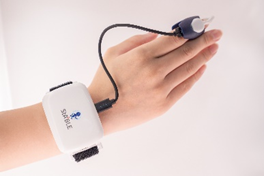
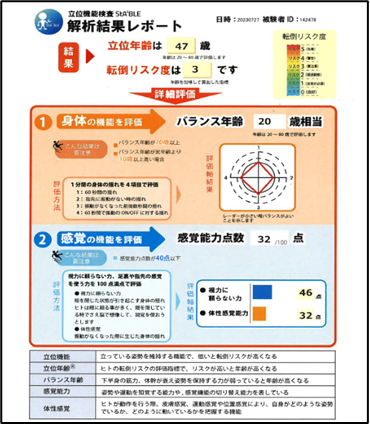
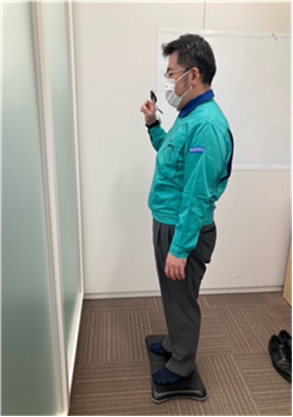
StA2BLE™ is a registered trademark of UNTRACKED Corporation.
(Photo courtesy of UNTRACKED Corporation)
Feeling Danger Physically: Experiential Learning
Kaneka Group is pursuing experiential learning(*2) to enhance sensitivity to risks. In addition to conventional hands-on safety experience equipment, we introduced virtual reality-based learning equipment. Through this initiative, we are working to increase safety awareness. In FY2024, a total of 2,767 individuals participated in the training.
*2Experiential Safety Training
・Real-life experiential training: 12 devices, including flat belt entanglement, chain/gear entanglement, and dust explosions
・VR experiential training: 18 scenarios, including falls from heights, falls down stairs, slipping on floors, electric shocks, explosions, and leaks
Safety training
The Kaneka Group is continuously engaged in developing safety personnel through various safety education programs, including risk assessment training, safety engineer training, and experiential learning. Additionally, we conduct line manager training for supervisors. In FY2024, a total of 1,361 employees of the Kaneka Group participated in safety-related training.
Chemical Substance Management (Preventing Health Hazards from Exposure)
We hold chemical risk assessment training each year to ensure accurate evaluation of chemical hazards and risks. We inspect chemical substance management in the workplace, checking labeling, risk assessments, and compliance with requirements for wearing protective equipment for designated substances. In FY2024, 46 participants took the course. Training participants become key personnel in their workplaces, conducting risk assessments and working to reduce risks based on the results.
Safety coordination with partner companies
We hold regular meetings with partner companies to share our annual safety and health management plans and track progress. We share information on accidents, incidents, near-misses, and process issues across the Kaneka Group and provide experiential safety training. By working together with partner companies, we aim to raise safety standards throughout all our sites.
| Training Name | Content | FY2024 Number of Participants |
|
|---|---|---|---|
| Safety Education | HAZOP Training |
|
72 |
| Training for dedicated safety engineers |
|
12 | |
| Human error prevention and analysis training |
|
12 | |
| Chemical Risk Assessment (CRA) Training (explosion and fire prevention module) |
|
46 | |
| Chemical Risk Assessment (CRA) training (health hazard prevention module) |
|
46 | |
| Risk assessment training |
|
28 | |
| Plant safety technology training (advanced course) |
|
12 | |
| Safety experience training (Preventing entrapment and entanglement) |
|
100 | |
| Safety experience education (static electricity, explosion, fire) |
|
100 | |
| VR safety experience education |
|
900 | |
| Line manager training | Safety training for newly appointed manufacturing general managers and production managers |
|
17 |
| Foreman management training: occupational safety and health law training |
|
16 |
Safety Awards
Certification as a Safety-conscious Company by the Japan Chemical Industry Association
| Group Company | Certification for Zero Accident and Disaster Period |
|---|---|
| Kaneka Sun Spice Corporation Shiga Plant | More than 10 years |
President’s Safety Award for No Accidents and No Disasters based on the Internal Standards (FY2024)
| Group Company | Award for Zero Accident and Disaster Period |
|---|---|
| OLED Aomori Co., Ltd. | September 9, 2010 — |
| Tamai Kasei Co., Ltd. | April 1, 2012 — |
| Kaneka Kanto Styrol Co., Ltd. | November 26, 2011 — |
| Kaneka Hokkaido Styrol Co., Ltd. | June 11, 2019 — |
| Kaneka Chubu Styrol Co., Ltd. | August 24, 2019 — |
| Kaneka Medical Vietnam Co., Ltd. | June 30, 2008 — |
| HiHua Fiber Co., Ltd. | September 7, 2019 — |
CHECK & ACT
In 2024, nine occupational accidents occurred. To achieve zero accidents, we will work to promulgate basic safety actions to all employees, improve production line management, and strengthen the risk assessment foundation.
